Insider Risk and Continuous Monitoring
Identity verification is the foundational layer of any Insider Threat Program. You cannot monitor insider risk without knowing, precisely and currently, who has access.
The Federal Mandate Context
Executive Order 13587 (October 2011) established the National Insider Threat Policy and directed all agencies with access to classified networks to establish an insider threat detection and prevention program. NISPOM Chapter 1, Section 1-102 operationalizes these requirements for contractors with facility clearances.
The policy is not ambiguous: cleared contractors are required to implement active Insider Threat Programs that monitor access to classified information and detect potential threats. The identity verification layer is not optional — it is the prerequisite that makes all other InTP monitoring meaningful.
Verifyfed does not perform behavioral psychology profiling, financial surveillance, personal device monitoring, or predictive threat assessment. The platform provides identity-layer monitoring — access events, verification status, and re-verification triggers — as inputs to your InTP. Your InTP case management and adjudication processes remain under your security officer's control.
REGULATORY REFERENCES
Executive Order 13587
Structural Reforms to Improve the Security of Classified Networks and the Responsible Sharing and Safeguarding of Classified Information (October 2011). Requires cleared contractors to establish insider threat detection programs.
NISPOM Chapter 1 §1-102
National Industrial Security Program Operating Manual — Insider Threat Program requirements for contractors with classified access. Defines program components, reporting requirements, and monitoring obligations.
What Verifyfed monitors at the identity layer.
The identity layer produces specific, documentable signals that contribute to your InTP monitoring requirements.
Access Pattern Anomalies
Authentication events outside normal working parameters: unusual access times, unexpected geographic authentication context, frequency anomalies in access patterns for a given contractor profile. Flagged for FSO review, not automated adjudication.
Re-verification Triggers
Automatic re-verification triggers on: clearance change flags, contract transition events, supervisor-initiated review requests, and configurable anomaly thresholds. Each trigger generates a documented re-verification event with timestamp and trigger reason.
Authentication Event Logging
All contractor authentication events logged with timestamp, device context, and outcome. Authentication failures, unusual device events, and multi-factor anomalies captured in the audit trail that feeds your InTP case management system.
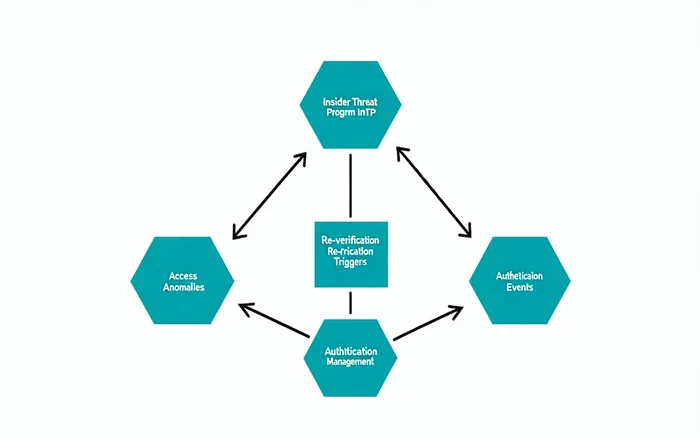
How Verifyfed fits your Insider Threat Program.
Verifyfed is an identity-layer component, not a complete InTP system. It contributes three things your InTP requires.
IDENTITY SIGNALS
Feeds Identity-Layer Signals to Your InTP
Access anomalies, re-verification trigger events, and authentication flags exported to your InTP case management system — ServiceNow GRC, Archer, or direct API. Your InTP receives structured identity events with supporting documentation.
PERSONNEL RECORDS
Generates Verified Personnel Records
NISPOM-compliant InTPs require current, verified records for each monitored individual. Verifyfed's verification records provide the identity foundation that InTP behavioral monitoring depends on — you cannot adjudicate a behavioral flag for a person whose identity is not verified.
AUDIT CONTEXT
Provides Audit Trail for UAM Context
User Activity Monitoring systems detect behavioral signals, but those signals require identity context to be actionable. Verifyfed's identity event audit trail provides the verified-identity anchor that your UAM system needs to contextualize monitored activity.
Your InTP starts with verified identity. Build that foundation first.
Schedule a briefing to discuss insider risk program requirements, identity-layer monitoring design, and how Verifyfed integrates with your existing InTP infrastructure.
Schedule a Briefing