Identity verification built for federal contractor security requirements.
Verifyfed helps Facility Security Officers and program security teams onboard and continuously monitor cleared personnel — aligned to FedRAMP Moderate, NIST SP 800-53, CMMC 2.0, and FISMA control requirements.
"Contractor identity verification is the last manual process in federal program security. It creates the backlog that delays cleared personnel deployment — and the gaps that create insider risk exposure."
- Manual clearance status verification at contract transitions creates onboarding delays measured in weeks, not days — holding up program work while security teams chase paper documentation.
- Decentralized personnel security files make DCSA inspection preparation a reactive scramble, with documentation gaps discovered only when auditors arrive.
- No continuous signal between initial identity proofing and annual re-investigation creates insider risk blind spots across multi-year contracts — exactly the exposure EO 13587 was written to address.
How Verifyfed Works
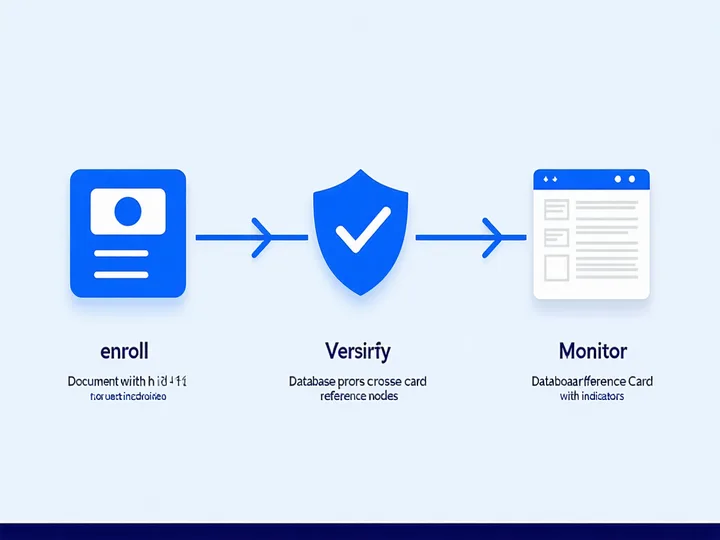
A three-phase verification workflow designed around the FSO's actual operational process, not a made-up product flow.
IA-1 / IA-4
Enroll
Contractor self-service identity proofing with government document capture, liveness detection, and consent workflow. NIST SP 800-63-3 IAL2 aligned.
IA-3 / IA-5
Verify
Identity attribute cross-reference against authoritative sources, clearance-awareness layer, background investigation integration hooks, and exception handling for security officer review.
AC-2 / AC-17
Monitor
Continuous risk signal monitoring, re-verification trigger rules, audit log generation, and insider threat signal aggregation for your InTP requirements.
Built around the control frameworks your program already operates under.
Verifyfed is designed to support alignment with established federal security frameworks. Not marketing claims — factual control family references for security officer evaluation.
IA and AC control families aligned to FedRAMP Moderate baseline requirements for govtech vendors.
See control mapping →IA-1 through IA-12 — identification and authentication control family, full coverage mapping.
See control mapping →3.5.x identification and authentication family for CUI protection applicability.
See control mapping →IA.1.001 – IA.3.084 practice coverage for defense industrial base contractors.
See practice mapping →Who uses Verifyfed.
Prime Contractors
Managing cleared personnel across large programs and subcontractor chains at scale. Centralized identity records and subcontractor visibility without proportional security headcount.
Learn moreSubcontractors
Meeting prime contractor and government identity requirements without enterprise overhead. Enterprise-grade identity tooling accessible to sub-contractor scale teams.
Learn moreFacility Security Officers
Maintaining NISPOM-compliant personnel security records and audit-ready documentation for DCSA inspection. Automated audit trails and real-time risk dashboards.
Learn moreFrom the field.
Clearance transition verifications used to take my team two to three weeks per contract. That bottleneck had real program consequences — cleared personnel sitting idle while we chased documentation. Having an automated verification trail changes the operational calculus entirely.
Facility Security Officer, mid-size defense prime — Crystal City, VA
When we got our first Secret-facility contract, our HR team had no framework for managing NISPOM personnel security requirements at scale. The complexity of maintaining compliant records across multiple cleared personnel was genuinely overwhelming. A system that organizes this properly matters.
HR Director, defense subcontractor, cleared facility — Tysons, VA
DCSA audit prep used to mean four days of pulling files and reconstructing timelines. Audit-ready documentation that's built into the verification process, not assembled after the fact, is exactly what program security needs at this compliance level.
Program Security Officer, federal civilian IT services contractor — Northern Virginia
Verifyfed is headquartered in Arlington, Virginia — at the center of the federal contractor corridor. Built by a team with first-hand experience in program security, personnel security investigations, and federal system authorization.
Program security starts with verified identity. Let us show you how Verifyfed fits your compliance framework.
Arlington, Virginia — serving federal prime contractors, subcontractors, and govtech vendors.
Schedule a Security Briefing